🔐 Why Cortex XSOAR Is Transforming Modern SOC Operations: Integration, Automation & Orchestration
Introduction 🚀
Modern Security Operations Centers (SOCs) are more complex than ever before. Organizations are deploying 10 to 50+ security tools across their environments to defend against increasingly sophisticated cyber threats.
From SIEM and EDR to cloud security and threat intelligence platforms, the security stack is powerful—but fragmented.
The result?
👉 Security teams are overwhelmed
👉 Alerts are increasing faster than response capacity
👉 Investigations take hours instead of minutes
This is not a technology problem alone—it is a coordination problem.
This is exactly where Cortex XSOAR (Security Orchestration, Automation, and Response) changes the game.
The Modern SOC Challenge: Too Many Tools, Too Little Integration 🧩
Today’s SOC environments typically include:
- SIEM (Security Information and Event Management)
- EDR (Endpoint Detection and Response)
- Firewalls and Network Security Controls
- Email Security Gateways
- Threat Intelligence Platforms
- Cloud Security Tools
- Ticketing and ITSM Systems
While each tool is powerful individually, the real challenge lies in integration and operational flow.
The Hidden Problem
Security analysts often follow a repetitive and inefficient process:
- Copy data from one tool
- Paste into another
- Correlate alerts manually
- Investigate across multiple dashboards
- Create tickets manually
This leads to:
- ⏱️ Delayed incident response
- 😓 Analyst fatigue and burnout
- ⚠️ Missed attack correlations
- 📉 Reduced SOC efficiency
Enter Cortex XSOAR: The Security Orchestration Engine ⚙️
Cortex XSOAR is designed to eliminate fragmentation by acting as the central nervous system of the SOC.
Instead of analysts manually connecting tools, XSOAR automates the entire workflow end-to-end.
What Cortex XSOAR Does in Real Time
When a security alert is triggered, XSOAR can automatically:
- ⚡ Pull context from SIEM logs
- ⚡ Query EDR for endpoint behavior
- ⚡ Enrich indicators using threat intelligence feeds
- ⚡ Analyze email artifacts and attachments
- ⚡ Investigate IPs, URLs, and file hashes
- ⚡ Create or update incident tickets
- ⚡ Trigger automated response actions
All of this happens in seconds, not hours.
How Cortex XSOAR Works in a Modern SOC Architecture 🏗️
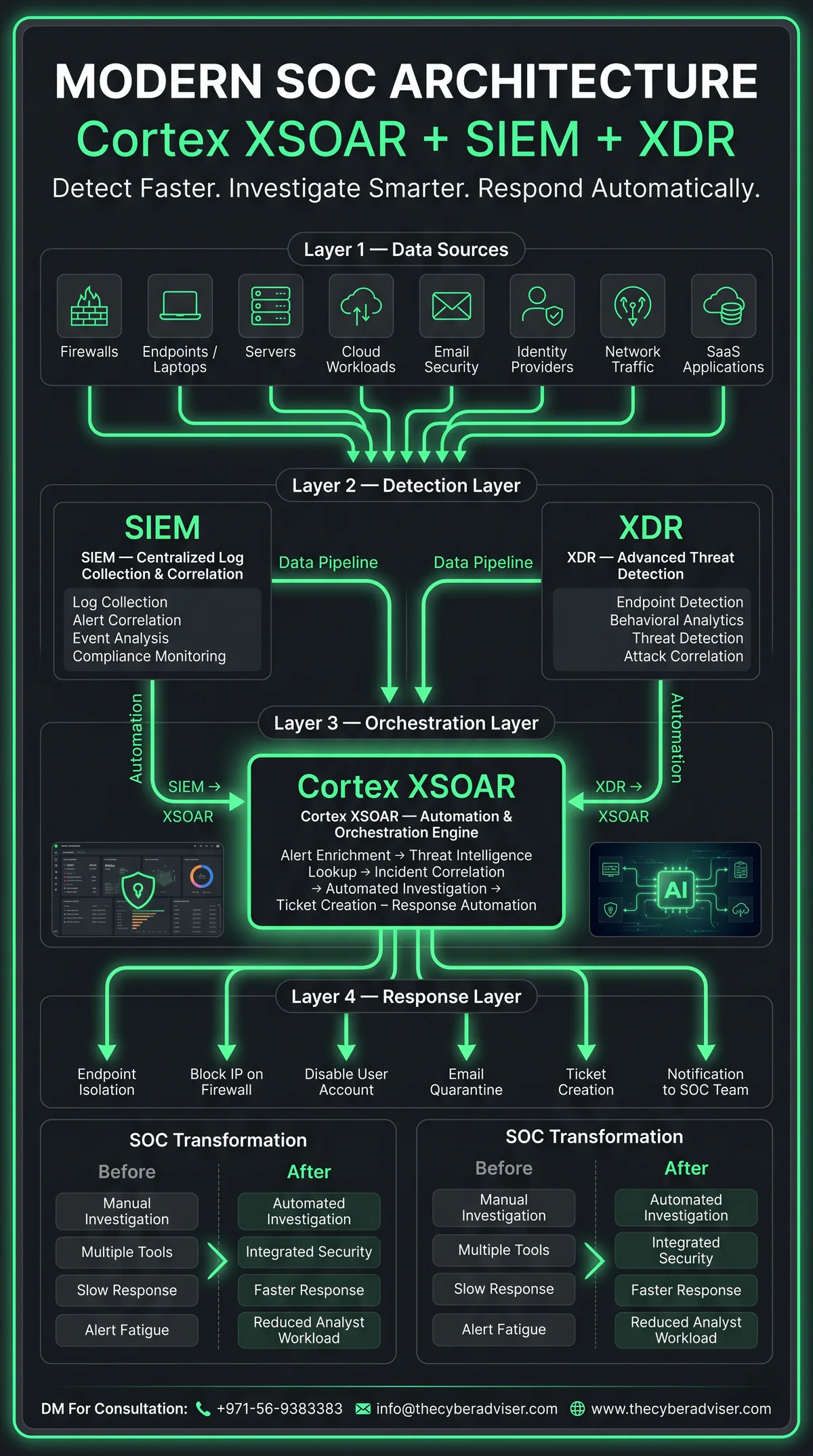
To understand its impact, we need to look at the SOC architecture in context. The modern SOC requires seamless data flow between detection and response.
🟦 Layer 1: Detection Layer (SIEM + XDR)
SIEM — The Log Intelligence Layer
SIEM platforms aggregate and correlate logs from across the environment:
- Network devices
- Applications
- Cloud platforms
- Identity systems
They provide:
- Event correlation
- Log analysis
- Compliance visibility
XDR — The Threat Detection Layer
XDR expands visibility across endpoints, networks, and cloud:
- Behavioral detection
- Attack chain analysis
- Endpoint telemetry
- Cross-domain threat correlation
🟨 Layer 2: Orchestration Layer (Cortex XSOAR)
This is the brain of the SOC architecture.
Cortex XSOAR receives alerts from SIEM and XDR and performs:
🔄 Automation & Orchestration Functions
- Incident enrichment
- Threat intelligence lookup
- Alert correlation across sources
- Automated investigation playbooks
- Workflow execution
- Ticket creation and updates
Instead of analysts manually switching tools, XSOAR acts as a fully automated decision engine.
🟥 Layer 3: Response Layer (Automated Security Actions)
Once an incident is validated, XSOAR can automatically execute response actions:
- 🚫 Block malicious IPs at the firewall
- 🔐 Isolate compromised endpoints
- 👤 Disable suspicious user accounts
- 📧 Quarantine phishing emails
- 🧾 Create ITSM tickets
- 📢 Notify SOC teams in real time
This transforms response from reactive to proactive.
Real-World Use Cases of Cortex XSOAR in Action 🌍
🔥 Use Case 1: Phishing Attack Response
1. Email security tool detects suspicious email
2. XSOAR automatically extracts URLs and attachments
3. Threat intelligence checks reputation
4. Endpoint scanning is triggered
5. Malicious email is quarantined
6. Incident ticket is created automatically
👉 Result: Response time reduced from hours to minutes
🛑 Use Case 2: Compromised Endpoint Detection
1. XDR detects unusual process behavior
2. SIEM correlates login anomalies
3. XSOAR enriches threat indicators
4. Endpoint is automatically isolated
5. SOC is notified with full incident context
👉 Result: Attack containment before lateral movement
☁️ Use Case 3: Cloud Misconfiguration Exploit
1. Cloud security tool flags suspicious activity
2. XSOAR correlates IAM logs and access patterns
3. Threat intelligence confirms malicious behavior
4. Access is revoked automatically
5. Incident is escalated to SOC team
👉 Result: Prevents privilege escalation attacks
Real SOC Impact: Before vs After Cortex XSOAR 📊
Before XSOAR:
- Manual investigation workflows
- Multiple dashboards to monitor
- High alert fatigue
- Slow response cycles
- Heavy analyst workload
After XSOAR:
- Fully automated workflows
- Unified incident view
- Faster detection-to-response time
- Reduced analyst burnout
- Smarter, more strategic SOC teams
The Real Value of Cortex XSOAR 💡
Cortex XSOAR does not replace your security tools.
👉 It unifies and amplifies them
The real transformation happens when:
- Tools stop operating in silos
- Data flows automatically across systems
- Analysts focus on decisions, not manual work
- Security becomes orchestrated, not reactive
Conclusion 🎯
Modern cybersecurity is no longer about having the most tools.
It is about making those tools work together intelligently.
Cortex XSOAR enables organizations to evolve from:
> ❌ Alert collection → Manual investigation
> ✅ Automated orchestration → Rapid threat response
In today’s threat landscape, speed is not optional—it is survival.
And with Cortex XSOAR, your SOC doesn’t just detect threats faster…
👉 It responds before the attacker succeeds.
Key Takeaways 📌
- SOC environments are highly fragmented across multiple tools
- Manual investigation slows down incident response significantly
- Cortex XSOAR automates and orchestrates security workflows
- SIEM + XDR provide detection, XSOAR provides action
- Automation reduces fatigue and increases SOC efficiency
- Modern SOC success depends on integration, not tool quantity
Hashtags 🔖
#CyberSecurity #SOC #CortexXSOAR #SOAR #SecurityAutomation #ThreatDetection #PaloAltoNetworks