Identity Is the New Security Perimeter
Why ITDR and Identity Analytics Are Becoming Essential for Modern SOCs 🔐
Cybersecurity has evolved dramatically over the past decade.
There was a time when security teams focused primarily on:
- Firewalls
- Network segmentation
- Endpoint protection
- Perimeter defenses
But today, the perimeter has changed.
Modern attackers are no longer trying to break into networks using loud, obvious methods.
Instead, they're using valid credentials to quietly log in and move across environments undetected.
This shift has fundamentally changed how organizations must think about security.
Identity is now the new security perimeter.
And this is exactly where Identity Threat Detection and Response (ITDR) and Identity Analytics become critical components of modern cybersecurity architecture.
The Shift: From Network Security to Identity Security
Traditional security models were built around protecting networks and endpoints. But modern infrastructures have become:
- Cloud-first
- Remote workforce enabled
- SaaS-driven
- API-connected
- AI-integrated
This transformation has dramatically expanded the identity attack surface.
Today, organizations must protect not just users, but also:
👤 Human identities
☁️ Cloud identities
🔑 Privileged accounts
🤖 AI agents and automation
⚙️ Service accounts
🔗 API tokens and integrations
These identities often have more access and privileges than traditional endpoints — making them highly valuable targets for attackers.
Modern Attacks: Attackers Don't Break In — They Log In
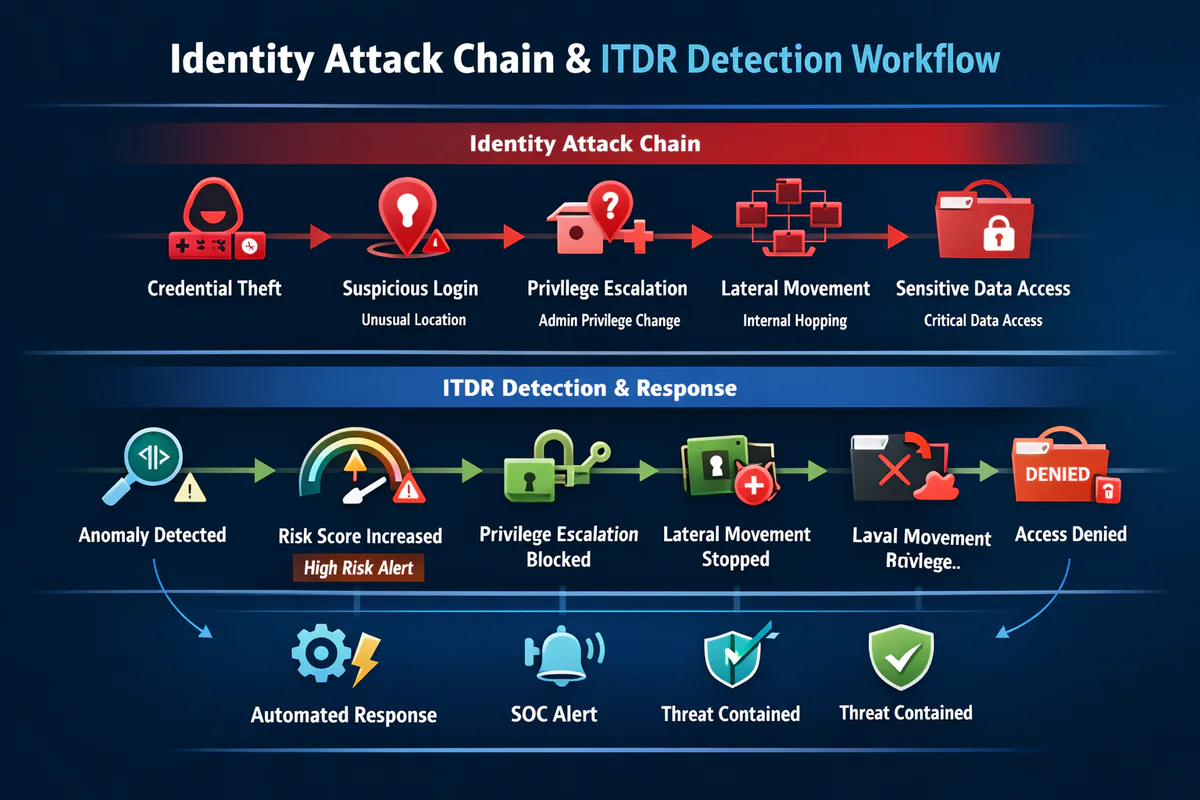
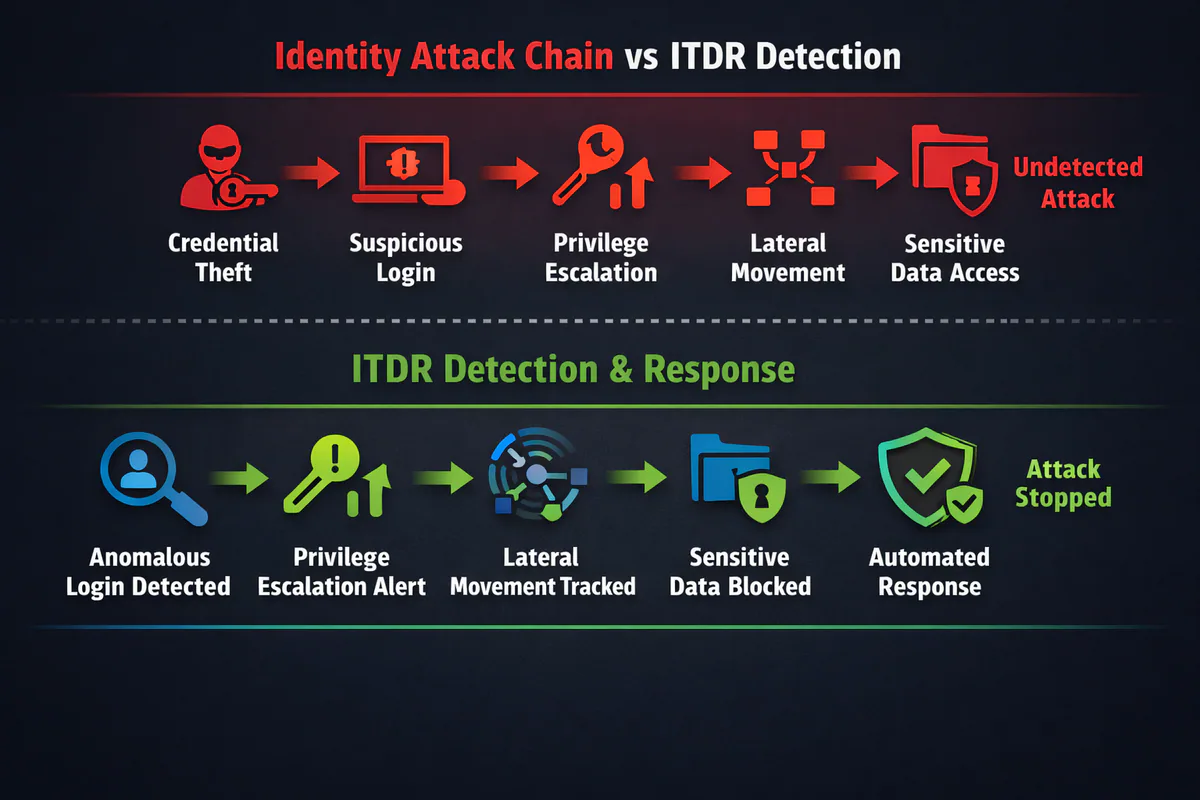
Modern cyberattacks often follow a predictable identity-based attack chain:
Credential Theft
⬇️
Suspicious Login
⬇️
Privilege Escalation
⬇️
Lateral Movement
⬇️
Sensitive Data Access
Because attackers use legitimate credentials, many traditional security tools fail to detect these activities.
This is what makes identity-based attacks particularly dangerous:
- They look like normal user behavior
- They bypass traditional defenses
- They operate silently
- They can persist for weeks or months
Without identity visibility, organizations remain blind to these threats.
What Is ITDR (Identity Threat Detection & Response)?
ITDR (Identity Threat Detection and Response) is a modern security capability focused on detecting and responding to identity-based threats in real-time.
ITDR platforms analyze identity behavior across environments and detect anomalies such as:
- Unusual login locations
- Abnormal access patterns
- Privilege escalation attempts
- Lateral movement behavior
- Suspicious service account activity
- Token abuse and misuse
Unlike traditional tools, ITDR focuses on who is accessing what — and why.
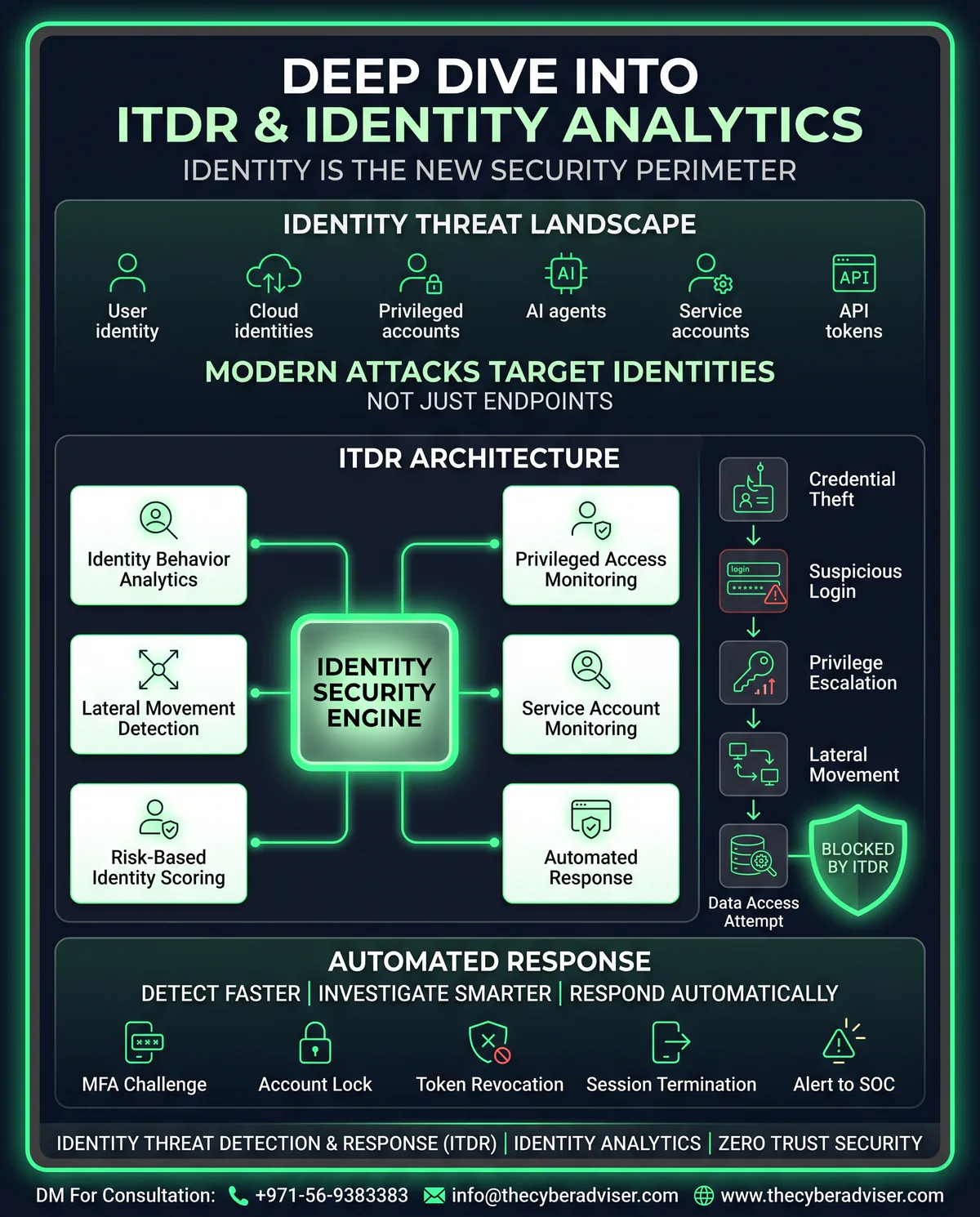
Core Capabilities of Modern Identity Analytics
Modern identity analytics platforms provide deep visibility into identity behavior through:
🧠 Identity Behavior Analytics
Detects abnormal login patterns and risky behavior using machine learning and behavioral analysis.
🔍 Privileged Access Monitoring
Tracks usage of high-risk privileged accounts and detects suspicious privilege changes.
🔗 Lateral Movement Detection
Identifies attackers moving across systems using compromised credentials.
⚙️ Service Account Monitoring
Detects unusual automation or service account activity.
📊 Risk-Based Identity Scoring
Assigns risk scores based on behavior, access patterns, and anomalies.
🤖 Automated Response
Triggers immediate actions when suspicious behavior is detected.
Real-World Attack Scenario: How ITDR Stops an Attack
Consider the following real-world scenario:
An attacker successfully steals employee credentials through phishing.
The attacker then:
1. Logs in from an unusual location
2. Attempts to access privileged resources
3. Moves laterally across systems
4. Tries to access sensitive data
Without ITDR, this activity may appear normal.
But with ITDR:
- Suspicious login detected
- Risk score increased
- Privilege escalation flagged
- Lateral movement identified
- Automated response triggered
Attack stopped — before data is compromised.
Automated Response: Stopping Threats in Seconds ⚡
One of the most powerful features of ITDR is automated response.
When suspicious activity is detected, modern ITDR platforms can:
🔐 Force multi-factor authentication (MFA)
🔒 Lock compromised accounts
🎟️ Revoke access tokens
🚫 Terminate suspicious sessions
🚨 Alert SOC teams automatically
This dramatically reduces:
- Mean Time to Detect (MTTD)
- Mean Time to Respond (MTTR)
- Overall attack impact
Automation ensures that threats are stopped before damage occurs.
Why Identity Security Matters More Than Ever
Several trends are accelerating identity-based risks:
- Rapid SaaS adoption
- Remote and hybrid workforce
- Increasing cloud environments
- Growth of AI agents and automation
- Expanding privileged access
- Sophisticated attackers
As identities grow, so does the attack surface.
Organizations that ignore identity security risk leaving their most critical assets exposed.
Identity-Driven SOC: The Future of Cybersecurity
Modern Security Operations Centers (SOCs) are evolving toward Identity-Driven Security Models.
In this model:
- XDR protects endpoints
- SIEM correlates events
- SOAR automates response
- ITDR protects identities
Together, they create a comprehensive security architecture capable of detecting advanced threats.
This identity-driven approach enables:
✅ Faster threat detection
✅ Reduced attack surface
✅ Automated response
✅ Zero Trust enforcement
✅ Stronger cloud security posture
Key Takeaways
- Identity is the new security perimeter
- Attackers increasingly target identities instead of endpoints
- Traditional security tools lack identity visibility
- ITDR provides detection and response for identity-based threats
- Automated response reduces detection and response time
- Identity-driven SOC is becoming the new cybersecurity standard
Conclusion
Cybersecurity is no longer just about protecting networks or endpoints.
It's about protecting identities.
As organizations continue adopting cloud, SaaS, and AI-driven environments, identity risks will only grow.
ITDR and Identity Analytics provide the visibility, detection, and response capabilities required to secure modern environments.
Organizations that adopt identity-first security today will be better prepared for tomorrow's threats.
Because in modern cybersecurity…
Your firewall protects your network
Your XDR protects your endpoints
But ITDR protects your identities
And today — that matters the most.
Hashtags
#CyberSecurity #ITDR #IdentitySecurity #ZeroTrust #SOC #CloudSecurity #ThreatDetection