⚛️ Quantum Computing is Coming
⚠️ Most Security Teams Aren't Ready
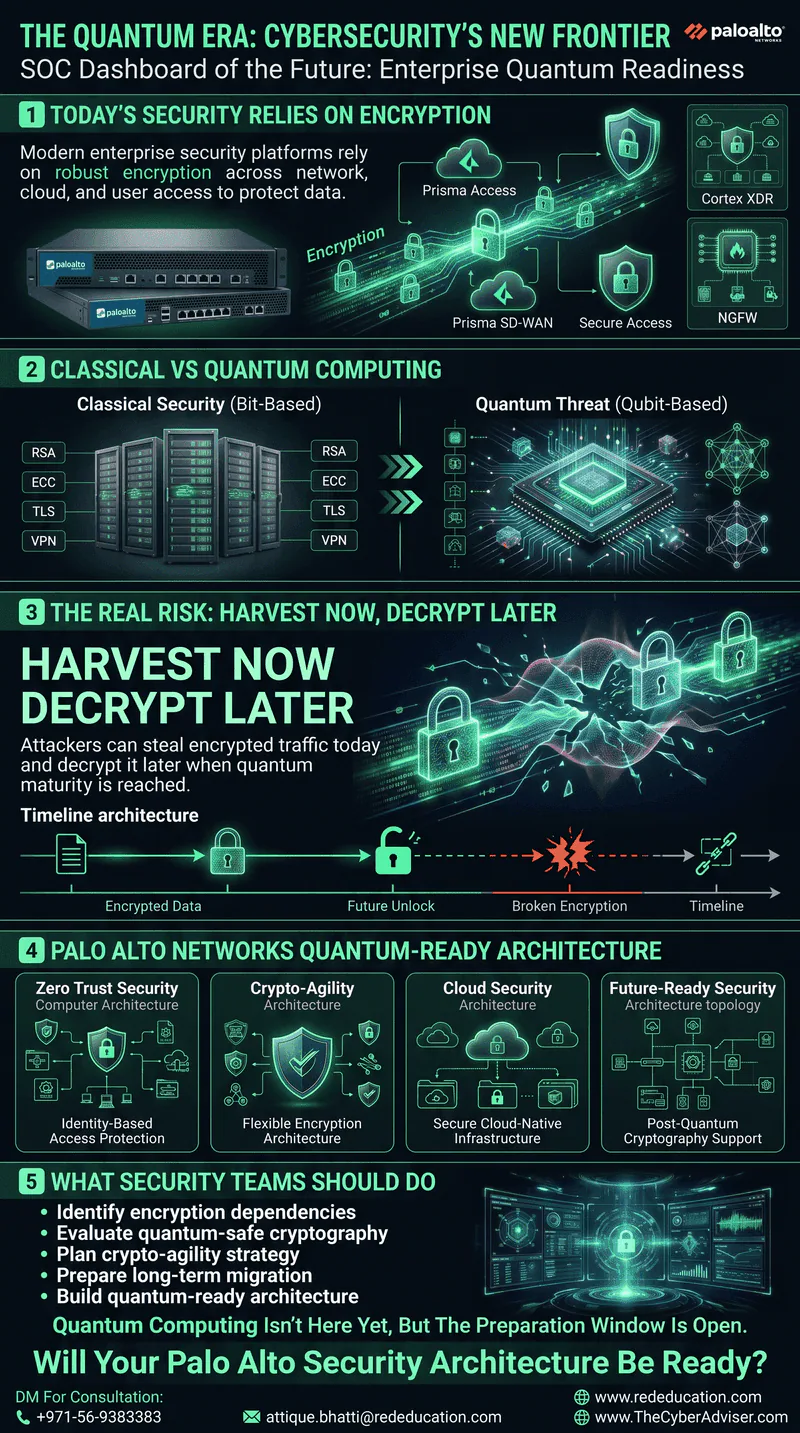
🔥 The Next Cybersecurity Disruption Has Already Started
For decades, cybersecurity relied on one core belief: Modern encryption is practically unbreakable.
That belief is now fading.
Quantum computing is moving from research labs to real-world capability — and when it reaches scale, it could break the cryptographic foundations of today's digital world. RSA. ECC. Diffie-Hellman.
These algorithms protect VPNs, banking systems, cloud infrastructure, digital identity, and secure communications. And they were never designed for quantum adversaries.
🧠 Why Quantum Computing Changes Everything
Classical computers use bits (0 or 1). Quantum computers use qubits (0 and 1 simultaneously), powered by Superposition and Entanglement. This allows them to solve complex mathematical problems — specifically those that form the basis of our current encryption — in minutes, rather than millennia.
🛑 The "Harvest Now, Decrypt Later" Threat
You might think, "We don't have quantum computers yet, so we have time." Wrong.
Threat actors are already engaging in Harvest Now, Decrypt Later (HNDL) attacks. They are stealing encrypted data today, knowing they can decrypt it in a few years when quantum power becomes available. If your data needs to remain secret for 10+ years, it is already at risk.
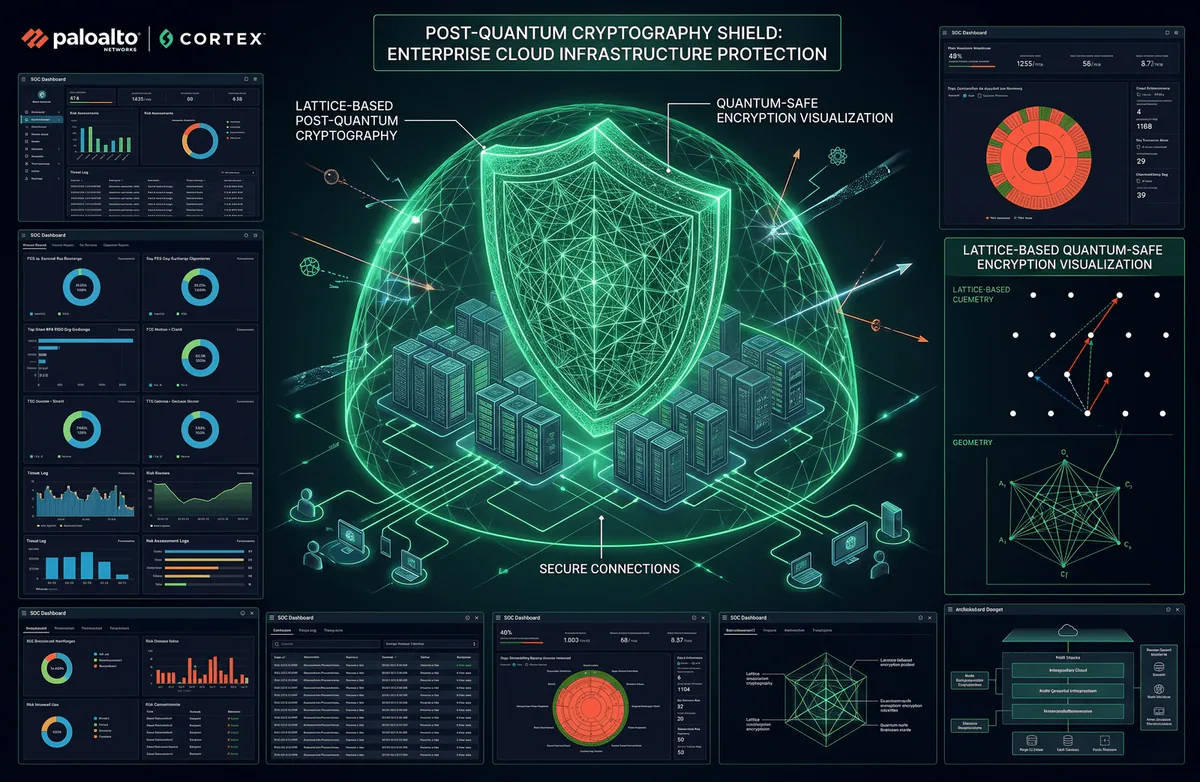
🛠️ How to Prepare: Post-Quantum Cryptography (PQC)
The transition to quantum-resistant security isn't just a software update; it's a fundamental architectural shift.
1. Inventory Your Encryption
Know where RSA and ECC are used in your environment today.
2. Prioritize Long-Life Data
Identify data that must remain confidential for a decade or more.
3. Adopt Crypto-Agility
Build systems that can swap cryptographic algorithms without rebuilding the stack.
4. NIST Standards
Start testing Kyber (ML-KEM) and other quantum-resistant standards.
What Security Teams Should Inventory First
A useful post-quantum readiness program starts with a cryptographic bill of materials. Do not limit the review to internet-facing certificates. The highest-risk dependencies are often buried inside infrastructure, identity, backup, and machine-to-machine workflows.
For each item, record the algorithm, key length, owner, renewal process, vendor dependency, and the business impact if the control must be replaced quickly. This gives the architecture team a factual migration map instead of a generic upgrade-encryption project.
Which Algorithms Are at Risk?
The main quantum risk is not that every cryptographic primitive disappears overnight. Symmetric encryption and hashing are affected differently than public key cryptography.
Public key algorithms such as RSA, Diffie-Hellman, and elliptic curve cryptography are the priority because Shor's algorithm targets the math behind factoring and discrete logarithms. These systems are used for key exchange, digital signatures, VPN negotiation, TLS handshakes, and certificate trust.
Symmetric algorithms such as AES and hash functions such as SHA-256 are more resilient, but they still need review. Grover's algorithm can reduce the effective security margin, which is why many organizations standardize on stronger key sizes such as AES-256 for long-life data.
Practical Migration Roadmap
Discovery and classification
Build the cryptographic inventory, identify internet-facing and partner-facing dependencies, and flag data with a confidentiality lifetime longer than five years.
Vendor readiness review
Ask firewall, SASE, cloud, identity, HSM, EDR, SIEM, and certificate authority vendors which NIST-standard post-quantum algorithms they plan to support.
Lab validation
Test post-quantum or hybrid cryptography in non-production environments. Validate TLS negotiation, VPN tunnel stability, inspection behavior, logging, renewal, monitoring, and rollback.
Crypto-agile deployment
Update architectures so algorithms can be changed without redesigning applications. Central certificate management and policy-driven TLS profiles matter here.
Production prioritization
Migrate systems that protect long-life sensitive data first, then public-facing services, partner connections, privileged access workflows, and internal machine-to-machine trust.
What This Means for Network and SASE Architecture
For enterprise security architects, quantum readiness is closely tied to network modernization. Remote access, branch connectivity, cloud transit, and inspection platforms all depend on cryptographic negotiation.
- Review which tunnels and portals rely on RSA or ECC certificates.
- Confirm whether certificate lifecycles are automated or still manually renewed.
- Test how TLS decryption policies handle hybrid or post-quantum handshakes.
- Check whether legacy appliances can support larger certificates, signatures, and updated cipher suites.
- Track cryptographic posture in SIEM, asset management, and architecture review workflows.
This is also a governance problem. Security architecture, network engineering, cloud engineering, application teams, and compliance owners need a shared migration backlog. Without that ownership model, post-quantum readiness becomes another spreadsheet that ages faster than the infrastructure it describes.
Readiness Checklist
- Create a cryptographic asset inventory and update it quarterly.
- Tag data sets by confidentiality lifetime: under 1 year, 1-5 years, 5-10 years, and 10+ years.
- Identify every RSA, ECC, and Diffie-Hellman dependency in VPN, TLS, PKI, code signing, identity, and backup workflows.
- Require vendors to document PQC support, hybrid-mode support, firmware requirements, and deprecation timelines.
- Test ML-KEM based key exchange and post-quantum signature options in a lab before production rollout.
- Add PQC readiness to security architecture reviews, cloud landing zone reviews, and third-party risk assessments.
- Define rollback procedures before changing production TLS, VPN, or certificate authority settings.
🏁 Bottom Line
Quantum computing isn't just a "future problem." The cryptographic transition is a multi-year journey that needs to start now. Is your security roadmap quantum-ready? ⚛️